
What Real Financial Inclusion Looks Like in the Digital Economy
Financial inclusion is not just about onboarding people into systems — it’s about enabling confident, fair participation in the digital economy.
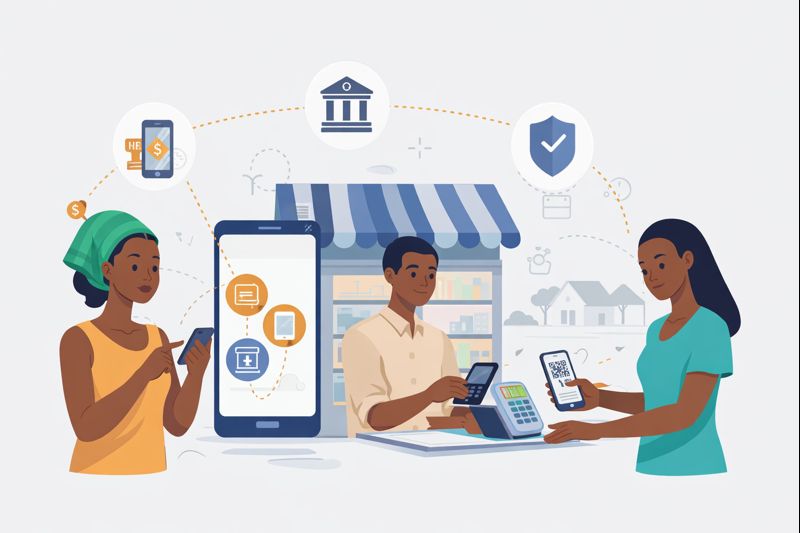
Financial inclusion is often spoken about in numbers — accounts opened, cards issued, wallets downloaded, terminals deployed. While these metrics matter, they rarely tell the full story. Real financial inclusion goes beyond access alone. It lives at the intersection of access, understanding, and equitable participation in the digital economy.
At the Tokata Foundation, we view financial inclusion not as a box to tick, but as a system to be built responsibly, with people — not products — at its centre.
1. Access Is the Starting Point — Not the Destination
Access is the most visible layer of inclusion. It answers questions such as:
- Can individuals open a basic account?
- Can small businesses accept digital payments?
- Are digital financial tools available in rural, peri-urban, and informal economies?
Across Africa and other emerging markets, access has improved dramatically through mobile money, digital wallets, agent banking, and QR-based payments. Yet access without usability is not inclusion.
Many individuals technically “have” access but:
- Do not trust the system
- Do not understand fees, risks, or benefits
- Cannot use the tools confidently or independently
- Are excluded by language, literacy, device, or data constraints
True inclusion asks a deeper question: Can people actually use these tools in ways that improve their lives?
2. Understanding: The Most Underrated Pillar of Inclusion
Understanding is where many inclusion efforts quietly fail. Financial systems are complex by design — layered with terminology, rules, compliance, security mechanisms, and unfamiliar digital behaviours. For first-time users, this complexity can be intimidating, even alienating.
Real inclusion requires:
- Financial literacy, not just product awareness
- Contextual education, delivered in familiar language and real-world scenarios
- Practical understanding, not abstract theory
When people understand:
- How digital payments work
- Why security steps matter
- How disputes, refunds, and errors are handled
- What rights and responsibilities they have
…they move from passive users to confident participants. Without understanding, access becomes fragile. With understanding, access becomes empowering.
3. Equitable Participation in the Digital Economy
Inclusion is not just about individuals — it’s about participation in economic value creation. Equitable participation means:
- Small and informal businesses can compete fairly
- Women, youth, and marginalised groups are not structurally disadvantaged
- Digital tools do not reinforce existing inequalities
- Fees, settlement cycles, and rules are transparent and fair
Too often, the digital economy mirrors the same exclusions of the traditional economy — just faster and at scale. Real inclusion ensures that:
- A street vendor has the same dignity in accepting digital payments as a large retailer
- A micro-entrepreneur understands pricing, settlement, and cash flow
- Communities are not just users of digital systems, but beneficiaries of them
Equity is achieved when digital finance levels the playing field instead of tilting it further.
4. Trust Is the Invisible Infrastructure
No financial system works without trust. Trust is built when:
- Systems are reliable
- Fees are clear
- Support is accessible
- Problems are resolved fairly
- Education is ongoing, not once-off
For communities historically excluded from formal finance, trust is not assumed — it is earned. Financial inclusion initiatives that ignore trust often see dormant accounts, cash preference returning, and digital tools abandoned after first failure. Trust transforms inclusion from a programme into a relationship.
5. Inclusion as Capability, Not Charity
At the Tokata Foundation, we believe financial inclusion is about capability building, not dependency. This means:
- Teaching how systems work, not just how to sign up
- Supporting long-term financial confidence, not short-term adoption
- Enabling communities to engage with digital finance on their own terms
Inclusion should expand choice, agency, and opportunity — not create new forms of vulnerability.
6. The Role of Education, Ecosystems, and Responsibility
Sustainable financial inclusion requires collaboration across:
- Educators and community organisations
- Financial institutions and fintechs
- Regulators and infrastructure providers
- Merchants, agents, and end-users
Education is the connective tissue that aligns these actors. When education is embedded into ecosystems: products are designed more responsibly, users are better protected, adoption becomes organic, and economic participation deepens.
Looking Ahead: Building Inclusion That Lasts
The future of financial inclusion will not be defined by how many accounts exist — but by how well people participate in the digital economy.
Real inclusion looks like:
- Access that is usable
- Understanding that builds confidence
- Participation that is fair and empowering
If financial inclusion is to truly change lives, it must be designed with intention, taught with care, and governed with responsibility. That is the standard we believe the digital economy must meet.